Laser Safety 101: Decoding the Science Behind Your Eye Protection
Welcome to the Safety Zone: A Necessary Introduction
If you operate a laser engraver—whether for profit, production, or passion—you are working with immense, focused power. The difference between a clean cut and a catastrophic eye injury is often measured in nanometers. This guide is your definitive, no-nonsense resource for understanding the one piece of equipment most critical to your long-term health: your eye protection.
What We Will Cover:
- The Invisible Danger: Why common wavelengths (CO2, Fiber, Diode, UV) demand specific protective measures.
- The Technical Codes: How to decode the essential ratings: Wavelength (nm), Optical Density (OD), and the L-Rating (EN 207).
- Practical & Legal Compliance: The required PPE for closed (Class 1) and open (Class 4) systems, and the legal mandates for industrial and educational settings.
- Spotting the Fakes: How to identify counterfeit glasses and vet legitimate vendors.
Your mastery of this information is the only thing standing between your vision and permanent damage. Let’s make sure you’re protected.
Due Diligence: Your Safety Checklist
Operating a laser requires due diligence. Even if your machine is fully enclosed and certified as Class 1, you are responsible for maintaining a pair of correctly rated safety glasses. Why? Because the moment you open the machine for maintenance, cleaning, or alignment, the safety enclosure is defeated, and you are operating a dangerous Class 4 laser.
The Invisible Danger: Why Lasers Demand Respect
That powerful beam of light energy can cause damage that is either instant and permanent (from a direct hit or strong reflection) or cumulative over time (from repeated exposure to scattered light or specific high-energy wavelengths like UV). To move past guesswork and ensure real safety, you must understand the technical science printed on your protective gear.
Core Concepts: Wavelength (nm) and Density (OD)
The Wavelength (nm): The Critical Nanometer Number
This is the single most crucial number in laser safety. Wavelength, measured in nanometers (nm), is the “color” or frequency of the laser light. Your protection must match this number precisely.
| Laser Type | Common Wavelength (nm) | Visibility | Key Safety Note |
| CO2 (Carbon Dioxide) | 10,600 nm | Invisible (Far Infrared) | Protection absorbs intense heat and energy (Thermal). |
| Fiber/MOPA | 1064 nm | Invisible (Near Infrared) | Extremely dangerous due to bounce-back reflections (Thermal). |
| Diode | 450 nm | Visible (Bright Blue) | Protection must block high-energy blue light (Often Thermal). |
| UV (Ultraviolet) | 355 nm | Invisible (Ultraviolet) | Considered a “Cold” Laser” as it breaks bonds (Photoablation). |
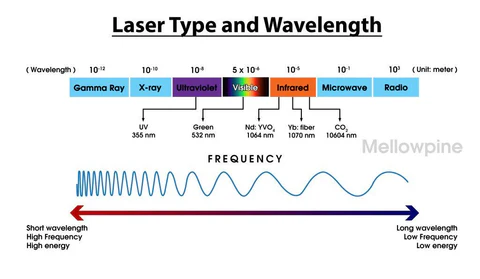
The CRITICAL Rule: You must match the nm numbers!
Safety glasses rated for one wavelength (e.g., 450 nm) offer zero protection against another (e.g., 10,600 nm).
The Myth of Color: Why Tint Doesn’t Mean Safety
A dark or colored lens is not inherently safe. Safety comes from the molecular composition of the material, not the visible tint. High-quality protection contains specialized absorbent dyes engineered to chemically absorb the energy of a specific laser wavelength. Always trust the ratings, not the color—a cheap, dark lens only blocks visible light, not invisible, concentrated laser energy.
Note on Tints and Viewing Windows: Tints and colors are added to proper safety windows and lenses (like the orange tint often used for blue diode lasers) specifically to filter out intense, visible light. This visible light filtering prevents eye strain, discomfort, and temporary injuries like “welder’s eye” (photokeratitis), after the invisible, dangerous wavelength has already been blocked by the core material.
The Blocking Power: Optical Density (OD)
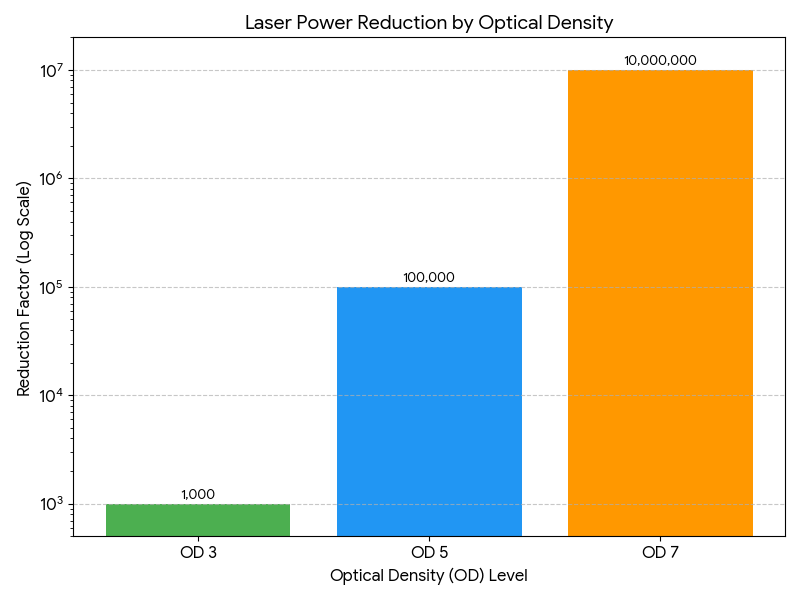
If the wavelength tells you which light to block, the Optical Density (OD) tells you how much to block. OD is a logarithmic measure of the material’s ability to reduce the laser’s power. For high-power cutting and engraving machines (Class 4), you typically need an OD 5 or 6 (or greater) to ensure the beam is reduced to a harmless level.
Decoding the L-Rating (EN 207)
Certified safety glasses use the L-Rating (the international EN 207 standard) to combine the wavelength and OD into a clear, verifiable safety mark.
A typical L-Rating looks like this: DIR 10600 L6
| Code Segment | Explanation |
| D, I, R, M | The Laser Mode. D (Continuous Wave) or I (Pulsed). Matches how your machine fires. |
| 10600 | The Wavelength (nm). Must exactly match your laser’s operating wavelength. |
| L6 | The Required OD Level. The certified protection that guarantees the material can withstand a direct hit or reflection for a safe duration. |
Fit and Function: Eyewear Styles
Protection must be worn correctly 100% of the time. The right style encourages compliance.
| Style | Pros | Cons |
| Glasses (Spectacles) | Lightweight, comfortable, good visibility. Best for short-term wear. | Less peripheral coverage, may have gaps around the temples or brow. |
| Goggles | Superior seal and full 360-degree coverage; adjustable straps ensure a tight fit. | Can trap heat and fog up easily; bulkier than glasses. |
| Over-the-Glasses (OTG) | Designed to fit over existing prescription glasses; essential for bespectacled operators. | Can be very bulky and heavy; requires two lenses to look through (minor distortion). |
Enclosures: Class 1 vs. Class 4
Your machine’s Laser Classification determines the necessity of protective gear.
| Classification | Meaning | Eyewear Required? |
| Class 1 | Inherently Safe. The machine is fully enclosed; the viewing window is certified protection. | Required for Maintenance! |
| Class 4 | Highest Risk. The laser beam is exposed (open-frame) or the enclosure is easily bypassed. | MANDATORY. Everyone in the room must wear correctly rated glasses. |
The Critical Maintenance Rule (Why you need glasses anyway):
While a Class 1 enclosure is safe during normal operation, the moment you open the hood, disable interlocks, or remove a panel for cleaning, alignment, or service, you are exposed to the full, raw power of a Class 4 laser. Always have proper, rated eyewear ready before performing any internal work.
Viewing Panels: The Critical Safety Window
One of the most common questions regarding DIY enclosures is, “Can I use a piece of plain, clear, or colored plastic for a viewing window?”
The short, definitive answer is: Absolutely not, for most high-power lasers.
Never trust your eyesight to uncertified materials. The viewing panel is a critical safety component and must be rated to reduce your specific laser’s power to safe levels (Optical Density, or OD).
The CO2 Anomaly vs. Diode/Fiber Lasers
The required panel material depends entirely on the laser’s wavelength. The CO_2 laser (10,600 nm) is the one major exception to the “no plain plastic” rule, but even then, there are serious caveats.
| Laser Type | Wavelength | Is Plain Acrylic Safe for Beam Blocking? | Recommended Material | Fire Safety Consideration |
| Blue Diode | 450 nm | NO. Clear or plain colored plastic is transparent to this wavelength. | Certified Laser Acrylic (e.g., orange/red) or Certified Glass | Acrylic can ignite from a direct hit or fire inside the enclosure. |
| Fiber
Nd:YAG |
1064 nm | NO. Near-infrared light is invisible and passes through easily. | Certified Laser Acrylic (e.g., green/light green) or Certified Glass | Acrylic can ignite from a direct hit or fire inside the enclosure. |
| CO2 | 10600 nm | YES. Plain acrylic/glass naturally absorbs this long IR wavelength. | Certified Safety Glass (Recommended) or Certified Acrylic | CRITICAL: Glass is a far superior fire barrier. Acrylic is combustible and can melt/spread a fire, which is a constant risk in CO2 cutting. |
Choosing a Certified Laser Safety Panel
When selecting a viewing window, focus on these safety ratings, which must be clearly visible and certified by the manufacturer:
- Optical Density (OD): This is the measure of laser attenuation (blocking power). For Class 4 lasers, you should look for a panel with an OD of 5+ to 7+ at your laser’s operating wavelength.
- Wavelength Protection: The panel must list the exact range it protects against (e.g., OD 7+ @ 450 nm) .
- Dual-Band Protection: If your enclosure uses multiple lasers (e.g., a diode and a fiber laser), you must use a single panel that is rated for all wavelengths used (e.g., OD 7+ @ 450 nm AND OD 7+ @ 1064 nm). These are typically very dark or specialized colors.
The Fire Safety Argument: Acrylic vs. Glass
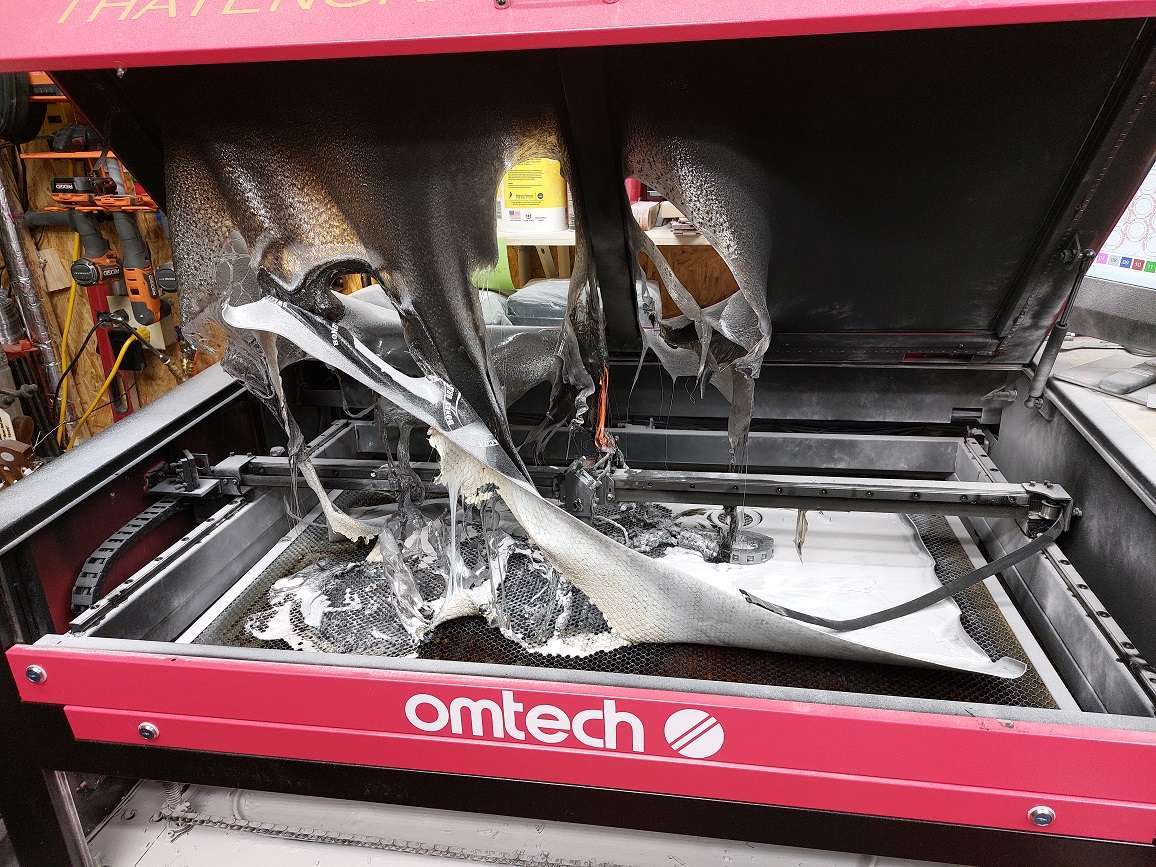
For CO_2 lasers, where the material is actively combusting during processing, your personal preference for glass is entirely justified and recommended:
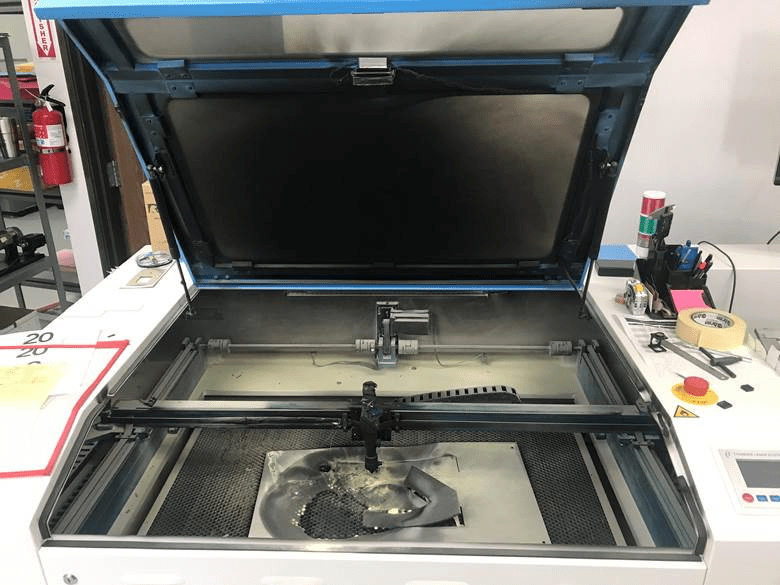
Fire Containment: While plain acrylic blocks the 10,600 nm beam, it is a thermoplastic that will melt and combust under heat, potentially compromising the enclosure and spreading fire. Laminated safety glass will crack but holds its structure longer and is non-combustible, offering a much higher degree of fire containment. Here is an example of glass containing a fire and of an acrylic lid contributing to the fire:
The Legal and Regulatory Mandate
For industrial, educational, and commercial operations, providing and enforcing the use of proper PPE is a legal requirement. Organizations like OSHA (Occupational Safety and Health Administration in the U.S.) and equivalent international bodies mandate adherence to established standards (such as ANSI Z136.1 in the U.S. or EN 207 in Europe).
Key Compliance Points:
- Training and Documentation: All personnel operating or maintaining the laser must be fully trained in the specific laser hazard and the correct use of PPE. This training must be documented.
- Availability: The correct eyewear must be readily available and in good condition for every person in the controlled hazard zone.
- Enforcement: Management is legally responsible for ensuring that all personnel don the required PPE during hazardous operations (e.g., alignment procedures or during Class 4 operation). Failure to enforce compliance is a violation.
Resources for Legal and Compliance
Ultimately, you will need to create your own specific compliance structure and documentation following these standards (and possibly others):
THESE APPEAR TO BE THE STANDING OSHA REGULATIONS FOR LASERS:
https://www.osha.gov/laws-regs/regulations/standardnumber/1926/1926.54
Here is some example documentation from various sources for your reference only:
- https://www.bc.edu/content/dam/files/offices/facilities/pdf/Laser%20Safety%20Manual%20FINAL%20version.pdf
- https://cws.auburn.edu/shared/files?id=227&filename=Auburn%20University%20Laser%20Safety%20Standard%20Operating%20Procedures%20Packet%20102618.pdf
- https://static.compliancetrainingonline.com/docs/industriallasersafety.pdf
- https://www.michigan.gov/documents/dleg/wsh_cetsp39_272060_7.pdf
- https://ehs.fullerton.edu/documents/forms/Laser%20Standard%20Operating%20Procedure_V4.0_12-2-2019_LL-Abby.pdf
- http://radiationsafety.utk.edu/wp-content/uploads/sites/20/2017/01/Laser-Registration-Form-Rev-2.pdf
- https://case.edu/ehs/sites/case.edu.ehs/files/2018-07/LASER-SAFETY-MANUAL_2018.pdf
- https://www.osha.gov/sites/default/files/2019-12/standard_operating_procedures.pdf
Practical Application: Comparing Eyewear
Here is a comparison of three common products. Use the Wavelength, OD, and L-Rating rules to spot the correct protection.
Laser Safety Eyewear Comparison Table
| Product | Stated Rating | Laser Type | Features | VERDICT |
| Cloudray | OD 6+ at 10600nm | CO2 (Far Infrared) | Polycarbonate Lens. Appears correct for a single, specific wavelength. | GOOD. Appears specific to CO2. Must verify L-Rating and CE/ANSI certification. |
| LaserPair | OD 6+ at 200-1400nm | Diode, Fiber, UV, Green, YAG | Polycarbonate Lens. Claims cover a massive range (UV through Near-IR). | DANGER! This is the “Combo Glass Myth” in action. No single filter offers verified OD 6+ protection across such a vast, critical range. HIGH RISK. |
| MCWlaser | OD 6+ at 9000-11000nm | CO2 (Far Infrared) | Polycarbonate Lens. Specifies a range that covers 10600nm. | GOOD. Appears specific to CO2. Must verify L-Rating and CE/ANSI certification, particularly if using high power. |
Note on multi-source laser equipment:
If your shop runs lasers of different types (like a Fiber/MOPA at 1064nm and a CO2 at 10,600nm), you must never trust a single pair of “broad-spectrum” or “combo” safety glasses advertised to cover everything.
Final Check: Comprehensive Buyer’s Checklist
| Feature to Check | Your Goal | Why It Matters |
| Wavelength (nm) | Must match your laser’s nm value. | If the number doesn’t match, the glasses offer no protection. |
| L-Rating | Must meet or exceed the level required for your laser’s wattage. | Guarantees the material can withstand a direct hit for a minimum duration. |
| VLT (Visible Light Transmission) | As high as possible, while maintaining the required L-Rating. | Higher VLT means better visibility, reducing trip hazards and eye strain. |
| Certification | Must be CE and/or ANSI Z136.1 certified. | Confirms independent testing and validation of the product’s claims. |
| Fit & Coverage | Must wrap securely and prevent any laser light from entering from the side or top. | Reflections are often the cause of eye damage in a working environment. |
The Final Warning: Avoid Fakes, Choose Vendors Wisely
The market is aggressively flooded with deceptive eyewear and misrepresented products. Your vision is not worth saving a few dollars.
- Vendor Vetting is Crucial: Never buy safety gear from untrusted marketplaces or unknown third-party sellers. Stick to respected, industry-recommended laser safety vendors who specialize in these products.
- Verify the Certifications: Once you have the product, cross-reference the CE or ANSI Z136.1 certification numbers with the manufacturer or a third-party safety organization. If the vendor cannot immediately provide a traceable Certificate of Conformity, walk away.
- No Indelible Marking: If the full nm and L-Rating are not permanently and clearly engraved or printed on the frame or lens (not a sticker), they are likely fake.
- Too Cheap to Be True: Certified, scientifically engineered laser safety materials are expensive. A pair of glasses that claims to offer L6 protection for $15 is a dangerous deception.
Thank You and Stay Safe
Thank you for taking the time to master these crucial concepts. The true measure of an expert laser operator isn’t just the quality of their cuts, but the quality of their safety protocols. Remember:
- Match the Wavelength.
- Verify the OD/L-Rating.
- Trust the Vendor, Not the Sticker.
Keep your vision protected, and happy engraving!
