
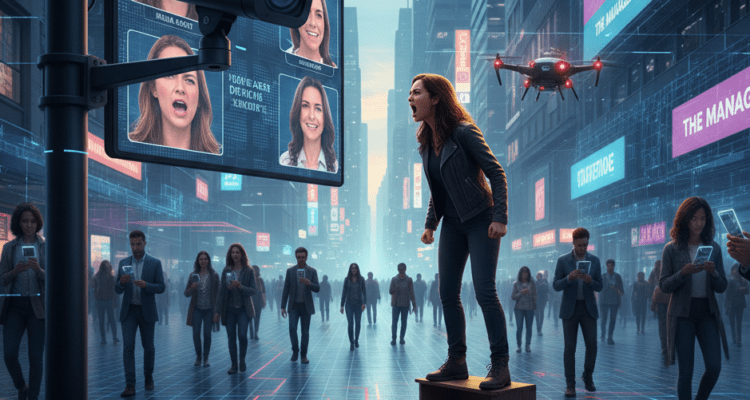
The next time you see a community board meeting erupt in fury over the installation of a Flock Safety camera or a new municipal facial-recognition grid, take a moment to observe the protestors.
Watch as they livestream their “resistance” on 5G-enabled smartphones, their exact GPS coordinates broadcast to a dozen data brokers in real-time. Watch as they return to homes guarded by Ring cameras and temperature-controlled by smart thermostats.
The irony is thick. We are witnessing a bizarre, performative ritual: the defense of a “privacy” that has not existed for two decades and a “freedom” that has been structurally dismantled. It is time to stop the hollering. It is time to admit that the illusion has finally been shattered.
The Myth of the “Opt-Out”
The fundamental flaw in the privacy movement is the belief that privacy is an individual choice—a door you can simply choose to lock. In a networked society, there are no doors.
We have built a world of Total Transparency, where your neighbor’s doorbell is your surveillance, and your friend’s social media photo is your facial-recognition entry. We live in a “Lateral Panopticon.” Unlike the prison models of old where a single guard watched the inmates, we now watch each other.
“Between dashcams, AirTags, and the digital breadcrumbs of every credit card swipe, the ‘private citizen’ has been replaced by the ‘traceable asset.'”
To demand privacy in one specific area, like a public road, while yielding it in every other aspect of life is not a principled stand; it is a failure of logic.
The Gilded Track of Modern Agency
If privacy is the first casualty of the digital age, “freedom” is the second. We cling to the word as if it still describes the ability to act without being managed. But look closer at the Choice Architecture that governs your day.
From the moment you wake up, your “decisions” are curated:
- Algorithms determine which news reaches your eyes.
- Predictive search suggests what you want before you finish typing.
- GPS tells you which route to take to work.
This is Algorithmic Determinism. You aren’t being forced to act; you are being “nudged.” Through a sophisticated mix of dopamine loops and predictive modeling, the system makes the “correct” choice the easiest one. We aren’t free agents; we are trains on a track, mistaking the speed of the engine for the autonomy of the driver.
The New Social Contract: Predictability over Liberty
The truth that no one wants to admit at a town hall meeting is that we like the managed life. We have signed a new social contract. In exchange for the end of privacy, we receive a world of frictionless convenience. In exchange for the end of freedom, we receive the illusion of total security.
We want the car thief caught by the license plate reader. We want the heart attack predicted by the smartwatch. We want the grocery store to know what we need before we run out.
You cannot have a smart city, a predictive healthcare system, or a globalized economy without the total harvesting of human data. The system requires predictability to function. An “untracked” human is a glitch in the software—a risk that the modern world can no longer afford to tolerate.
Post-Privacy Realism
It is time to retire the chest-beating rhetoric. The “spying” isn’t an overreach; it is the environment. We are part of a singular, managed, technological organism. The sensors on the street corners and the trackers in our pockets are simply the nervous system of that organism.
To complain about a camera today is like a passenger on a plane complaining about the altitude—you are already in the air, and the systems keeping you there require total control of the environment.
The “illusion” of privacy served its purpose during the transition, providing us with the psychological comfort needed to build our own cages. But now that the grid is complete, the illusion is an unnecessary weight. We are not being watched; we are being integrated.
If you’re still hollering about it, you’re simply yelling at the sky for being blue.

